Showing posts with label games. Show all posts

Sunday, February 14, 2010

Eye Exercise Guide

Yesterday I read bits of this blog at the Artclash Collective's annual Fun-A-Day event in Philadelphia. I also had people trying out some if the eye exercises that I posted on this blog each day during the month of January. Several people (and if you're reading this, maybe you're one of them) asked me more about the blog because they or someone they know has difficulty seeing.

I realize that it can be intimidating to jump on into this corner of the Blogosphere and sift through 31 posts instructing you to do 31 weirdo rituals that may or may not help you see better. This Valentine's Day addendum is a way to sort that out. Below are all 31 exercises, categorized and described in brief. Look 'em over, pick one or two, try 'em out, and let me know what happens. You can also use the entry entitled "Your 5-Minute Regimen" as a launching point for exploring this stuff.

Eye Exercises:
  • Sunning: Uses light, warmth and movement to help the eyes adjust to different lighting conditions.
  • Palming: Uses darknes and warmth to help relax the eyes and brain.
  • A Better Blink: Works to relax the eyes and face.
  • Directionals: Eye movements to help strengthen the muscles around the eyes.
  • The 3-Finger Game: Strengthens the ability to quickly focus on objects at different distances.
  • The Phantom Finger: Uses optical illusions to work stereoscopic vision.
  • Swaying & Swinging: Using movement of the head and body to help the eyes adjust to a world of motion.
  • Sketching: Uses movement of the head to help define and sharpen images.
  • A New Vision For Old Flyers: Uses printed words to help bring things into focus.
  • Describing: Partner exercise that helps one see more detail.
  • Seeing The Invisible: Works with the other senses to increase visual perception.
  • Look Out: Relaxes the eyes by looking far away.
Breathing, Massaging and Stretching:
  • Breathing: Basic technique for taking deep breaths during all eye exercises.
  • Neck Stretches: Reduces tension in the body caused by eyestrain.
  • Orbital Massage: Relieves eyestrain and headaches.
  • Massaging Meridians: Explores pressure points around the body to help improve the eyesight.
  • Buzzing: Yogic breath technique that brings relaxation to the eyes and body.
Shifts in Habit, Perspective and Attitude:
  • Reading: Instructions on how to read and use computers in a way that reduces eyestrain.
  • Changing Views: Using an apple (the fruit, not the computer) to see the world in many ways.
  • Make Art: How art can help improve vision.
  • See What You Want: Describes how vision loss can be linked to bad experiences and ways to overcome this.
Playing Games:
  • Spooning Bubbles: Increases spatial awareness and improves depth perception by blowing bubbles.
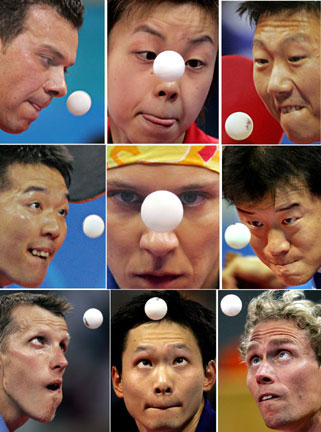
  • Ping Pong: Works focal ability by playing ping pong, tennis, or soccer.
  • Skipping Rope: Strengthens peripheral vision with a jump rope.
  • Anagram Games: Improves the eye-brain connection with a variety of word games.
Nutrition:
  • Herbs: Lists herbs linked to vision improvement and how to use them.
  • Listening to Color: Lists a few foods purported to be good for the eyes.
Essays:
...and for specific topics and eye conditions, look at the "areas of interest" on the sidebar to the left.

Tuesday, January 26, 2010

26. Changing Views

The Idea: Vision is more than physical eyesight: Our experiences inform our vision. By tapping into our experiences, we can heighten our sense of vision. By widening our experiences, we can increase visually ability exponentially.

Set Up: For this exercise you'll need an apple or some other object. The example given here uses an apple.

How To:
1. Imagine that you are hungry and look at the apple. Look at it with feelings of desire you sink your teeth into it and biting off a chunk of its sweet flesh. As you look at the apple, think about its taste and its power to nourish you and satisfy your craving. Look at the apple through this lens of desire. Now close your eyes and let that go—you are no longer a hungry person.
2. Open your eyes and look at the apple through the perspective of a painter. Your desire for this apple is no longer about flavor or nourishment, but about line, color, contour, texture, light an shadow, and how these aspects can be translated into an image with oils and a brush. Though your desire for this apple is purely aesthetic, feel it just as strongly as you did when your were hungry. Now close your eyes and let that go—you are no longer a painter.
3. Put your hands behind your back and open your eyes. You are now 7 years old and at a Halloween party and this apple is floating, with others, in a barrel of cold water. Your desire for this apple is now strategic: How can you clamp your little mouth around this big round fruit and pull it ou of the water before your face freezes off? That is the objective in a game of Bobbing for Apples and therefore your strongest desire in this moment. Now close your eyes and let that go—you are no longer a little kid.
4. Open your eyes and look at the apple and imagine that it is huge—looming up in front of you. Now you are a tiny worm, preparing to burrow into the side of this apple. Look at it from this perspective: Where would be the best place to tunnel in?
5. Continue closing the eyes, shifting perspectives, and looking at the apple through the lens of different desires.

What's Going On: Each time we look at something with varying intentions, we inevitably pick up different details about that thing. The same automobile will look different to a mechanic, a chauffeur, a meter maid, and a car thief, but someone who's been more than one of things will notice more aspects of the auto. This exercise uses the brain, as well as the eyes, to improve the vision.

Testimonial: I've led this exercise with friends and students, bringing apples into my classes (yoga and theater) and giving one to everybody. It's a great meditation to begin a lesson with, and then to return at the end with people possibly choosing to eat their apples.

More Info:
• I took this exercise from Marc Grossman's book Greater Vision.

Monday, January 25, 2010

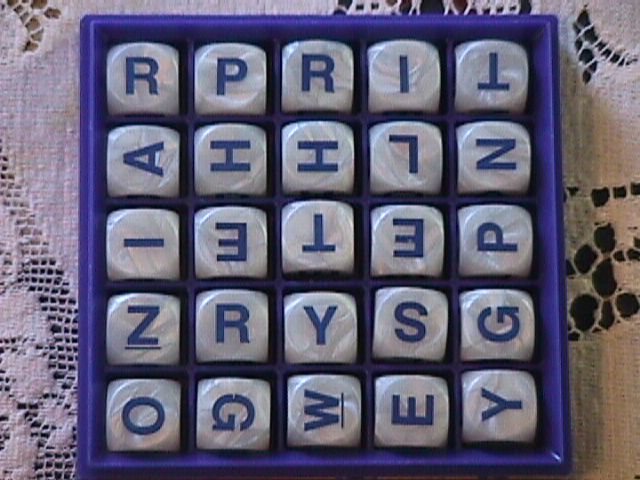
25. Anagram Games

The Idea: Word games require a variety of skills: the ability to spell and having a wide vocabulary are the most basic. Many word games also require the ability to look at things with the eyes and then re-envision their configuration with the brain—to derive words from jumbles of random letters. This is very useful for working the eye-brain connection and improving the vision. Here's are a few games with variations for improving the vision. Some are based on games commonly found in stores and people's homes, others require only pencil and paper:

Boggle: 16 or 25 letter cubes get mixed around and then fall into place in either a 4x4 or 5x5 grid (the 25-cube version is the best). The object of the game is to make as many words as possible by connecting adjacent strings of letters. In competitive play, this is done with a timer, but the game can be played solo and in a relaxed manner, simply by looking at the grid of letters and finding words. You can also do this just by typing or writing out a random grid of letters, or using letter tiles from other other words games (see below).

Bananagrams or Speed Scrabble: Bananagrams is fun and simple game sold as 144 tiles in a banana-shaped pouch. Players draw 21 tiles and make crossword configurations and try to use all of their tiles. If stuck, a player can say "Dump" and exchange 1 tile for 3 others in the pool. A player using all their tiles calls "Peel" and each player must draw 1 tile and continue playing until all the tiles are used. The game can also be played using the 100 tiles from a Scrabble set, 200 tiles from Super Scrabble, or just by writing letters on little slips of paper.

Secret Letters: You can "up-level" the above games by playing this variation where words are formed from a jumble of letter tiles, but the tiles remain jumbled in the center of the table. Here's how:
Step 1: Form a pool of 20 face-up tiles in the center of the table.
Step 2: Each player receives a face down tile, called "Secret Letters," which only they may look at.
Step 3: Without touching the tiles in the middle of the table, players take turns forming words of 4 or more letters, keeping track of which letters have been used. Words cannot be formed from tiles that have already been used.
Step 4: A player may turn over a Secret Letter to use it as part of a word—or to join with the letters of an already existing word, thereby forming a new word.
Step 5: When no more words can be made, the round is over. Each player scores 1 point for word created.
Step 6: Deal out the next round, increasing the number of tiles in the pool by 1, and the number of Secret Letters in each player's hand by 1.

What's Going On: The ability to conceptualize things that make sense out of jumbles of nonsense increases our ability to see and think clearly.

Testimonial: I've always been drawn to these kinds of games and find that one gets better at them with practice. They helped me stabilize my vision, boost my vocabulary, and have fun with friends and family.

More Info:
• Secret Letters came from Marc Grossman's book, Greater Vision, where he explains more about how these games improve the vision.
• David Parlett has some awesome books about word games, most of which don't require any equipment to play. He's also posted some online here.

Saturday, January 23, 2010

23. Spooning Bubbles

Okay. . . I realize that this blog is a bit odd—esoteric, eccentric, new-age-ish, wingnutty, and even smacking of quackery at times. The idea of doing eye exercises every day that may or may not improve the vision may not seem like everyone's idea of "fun," and writing about them so diligently definitely takes a certain brand of dedication to something that most folks just do not do or even validate.

And Yet . . . This stuff can be fun. These bizarre little activities do help people to relax into seeing the world in new and improved ways. And some of these exercises can be done in the name of playfulness—like this one:

Set Up: You'll need a a container of soapy fluid, a bubble wand, and a spoon.

How To: Blow bubbles and catch them with the spoon.

What's Going On: Bubbles are beautiful and chaotic in their size and movements. By trying to catch them the eye-brain connection works to deal with perception of similar objects (bubbles) of different sizes, at different distances, moving at varied rates. The aesthetic of watching and catching bubbles is also fun and relaxing, and this aids the vision further.

More Info:
• Marc Grossman describes this bubble game as a vision exercise in his book Greater Vision.

Friday, January 22, 2010

22. Ping Pong

The Idea: Yesterday's post described how the process of play can stimulate the eye-brain inter-sensory connection. Here are some more eye exercises in the form of games that kids and adults play all over the word.

Set Up: You'll need a smooth wall, a ping pong paddle and ball. If you're doing this with a friend, you might as well play a proper game of ping pong on a table. If your vision prevents you from playing ping pong, try something with a bigger racquet and ball—tennis, squash, badminton, etc. If this is still too challenging, use a soccer ball and a wall outdoors.

How To: This exercise has several variation based on the above options. All work best as vision exercises if they're done regularly—more than once a week:
• Ping Pong (or Tennis/Squash/Racquetball) for One: Practice hitting the ball with the paddle or racquet so that it bounces off the wall, intercepting it as it comes back, keeping score by seeing how many consecutive hits you can make.
• Ping Pong (or Tennis/Squash/Racquetball) for Two: Simply play ping pong on a ping pong table or any of the other sports on their usual courts.
• Soccer for One: Stand about 3 meters (10 feet) from a wall and kick the ball so that it bounces off the wall, intercepting it as it bounces back. Gradually work you way down to balls of smaller sizes, kicking, throwing, or paddling the, back and forth.

What's Going On: The movement of the ball traveling quickly toward and away from the eyes exercises focal abilities and depth perception, as well as stereoscopic vision.

Testimonial: One of high school teachers had become more myopic from all the reading she had to do in college. She knew this because as the semester dragged on, she had to sit closer and closer to the front of the room during lectures. She took up playing ping pong and tennis every day and soon regained her distance vision. Likewise, when I was a kid struggling with an eye disease that I did not yet understand, I played the soccer-ball-against-the-wall game outside and also practiced throwing and hitting a tennis ball against the walls in the hallway of my mom's apartment. I did these things intuitively, some piece of me knowing that that this was what I needed to do to preserve my vision. It worked, to some extent.

Wednesday, January 20, 2010

20. Look Out

The Idea: With more of us spending more and more time in front of screens, the tendency towards myopia is on the rise. Doing paperwork and computing is often associated with stress: when the eyes are continuously focusing on near, detailed things, the eyes and the mind tend not to be relaxed. Meanwhile, being outside and enjoying the beauty of nature is generally thought of as relaxing. When we see beautiful things, especially at a distance, the eyes and the mind have an easier time relaxing. This exercise brings consciousness to that tendency.

How To:
Step 1: Stand somewhere outside. Relax the faces, neck and shoulders. Breathe deeply.
Step 2: Pick 6 points to look at: 3 on the horizon—one to the left, one in the middle, and one to the right—and 3 more points to the right, middle and left, still off in the distance, but a bit closer than the first 3 points.
Step 3: Let the eyes rest on one of the points. Take a deep breath, inhaling and exhaling, and then move the eyes to another one of your points. Keep doing this, establishing a pattern of moving the eyes from one point to another.
Step 4: Repeat the pattern a few times, continuing to breathe and relax.

Testimonial: I was once with some friends at a house on a lake in Vermont. While everyone else sat on the dock, enjoying the view of the lake, the trees, the sunset and the clouds over the mountains, I was unable to relax. I wanted to be inside reading, playing boardgames, or doing puzzles. My mind could not relax and it demanded myopic stimulation. This habit of not relaxing was fed by the intense myopia from which I suffer, and my myopia gets perpetuated by this same habit in a vicious cycle.  I find that when I spend some time consciously looking off into the distance, I break this cycle. My eyes and my mind relax and my vision improves.

More Info:
• Meir Schneider recommends these practices in his audiobook, Meir Schneider’s Miracle Eyesight Method (published by Sounds True, 1996). Schneider talks about this in a video posted at the bottom of my blog entry about Reading. That post also has more info about developing better habits to counteract myopia.

Monday, January 18, 2010

18. Seeing The Invisible

The Idea: Things are easier to see when we know where they are. We can use senses other than vision to do this: we have two ears to be able to discern where in space a sound comes from, and our skin sends us messages about the location of different textures and temperatures. These other senses actually help us to see. Here are two exercises that help build on this ability:

How To:
Step 1: Sit or stand in a relaxed comfortable position. Raise one hand to eye level and rub the thumb and forefinger together.
Step 2: Keeping the eyes closed, look at your hand. Even though you can't actually see it, focus the eyes to where you know it to be.
Step 3: Keep rubbing your thumb and forefinger together as you move your hand around—down, up, right, left, nearer and further from the face. Follow your hand's movements with your closed eyes, switching hands if your arm gets tired.

Variation In Pairs:
The above exercise can be done with one person having eyes closed and another snapping fingers. The person with closed eys loks toward where the snapping sound is coming from.

What's Going On: When your eyes are closed, your brain has a general idea where in space your hand is. By rubbing your fingers together, your sense of touch feeds your brain more information about where your hand is. By keeping the eyes closed and directing them to your hand, your brain is sending your focus to a particular spot. This strengthens the ability to do this when the eyes are open. In the two-person variation, the same thing is happening via your sense of hearing instead of touch. Also the two-person variation is dealing with an unknown object—the other person's hand is not attached to you, so you cannot be certain where it is—whereas when you do this exercise with your own hand, the object is known. By doing both versions of this exercise, one can hone the coordination of the senses.

More Info:
• This exercise, and many others, can be found in Marc Grossman's book Greater Vision.

Tuesday, January 12, 2010

12. The Phantom Finger

The Idea: Our eyes are taking in every image in front of them—only the brain is selective about what it sees. Part of the work of natural vison therapy is training the brain what to see (eyes + brain = vision). We can also train our brains to see things that aren't actually there, therefore expanding the brain's ability to see what is actually there. And there's nothing like a common party trick to get the job done.

How To:
Step 1: Bring your index fingers to eye level, about 20 cm in front of the face with tips pointed at each other, about 1 cm apart.
Step 2: Look at the space between your fingers. Do you see a third, double-ended finger floating between them? Look for it.
Step 3: Once you've got your Phantom Finger established, move it around—bring the fingers slowly up and down to the edges of your visual field, move them closer and further away, close the eyes and then open them—always maintaining the visual belief that the Phantom Finger is still there.

What's Going On:
The eyes see two fingers, but the brain puts their back ends together to make a third, sausage-shaped finger in the middle. This works the eye/brain connection of stereoscopic vision and is a useful exercise for anyone who has a "lazy" eye or sees things more clearly in one eye than in the other. Step 3 of the exercise—using movement and closing the eyes—helps strengthen both the breadth of the visual field as well as ability to focus at different near distances, while training the brain to see what we want it to see.

More info:
• Dr. Marc Grossman loves using these kinds of eye-brain tricks to help people see. He's collaborated with artists on some "Magic Eye" books, saying that they're good for the vision—the eyes and he brain working together.

Wednesday, January 6, 2010

6. The 3-Finger Game

The Idea: Stereoscopic vision is the brain's ability to coordinate the separate images taken in by each eye and combine them into one image/idea. When the eyes focus on an object in a relaxed manner, the mind is focused and relaxed as well. The converse is true: when the eyes are straining to focus, the mind is strained and unfocused, which leads to more strain on the eyes. By getting the eyes to focus with relaxation, we relax the mind, paving the way for better vision.

How To:
Step 1: Sit or stand in front of a wall without any visual distractions on it. Hold one hand 15–20cm in front of your nose, the other twice that far, index fingers pointed up, other fingers curled down.
Step 2: How many index fingers do you see? Really there are only 2 fingers, but how many do you see?
Step 3: If you see 3 fingers, are the 2 that are side-by-side on the hand closer to your nose or further from your nose? Whatever the case, switch so that the double-finger is on the other hand.
Step 4: Keep switching, so that you see 2 index fingers on the hand closer your nose, then further, then closer, and so on.
Step 5: Should you drift into seeing any other
number of index fingers, relax into seeing 3.
Step 6: Remember to breathe, relaxing to switch rather than straining.

Variation—The 4-Finger Game: The 3-Finger Game can also be done with an additional point in the distance—a pine tree, telephone pole, church steeple, etc.—switching focus from the near finger to the further finger and then the far-off object. In focusing on this far-off object, how many index fingers do you see?

What's Going On:
• Each of our eyes sees its own version of reality from its own angle. When we focus on an object at a certain distance, the brain takes each eye's perspective and combines them into a single "3-D" image. Meanwhile images at other focal distances become distorted and part of the brain's job is to filter out this information. Our mental focus is in line with our visual focus.
• The 3-Finger Game works the eye/brain connection in being able to focus on things at different distances. In seeing one close finger and two further away fingers, we're exercising our ability to focus on close objects. Switching to seeing two close fingers and one further away finger, we're exercising our ability to focus on objects at a medium distance. In the variation where we look at a third object a bit further off (and presumably seeing 4 index fingers), we're exercising our distance vision.
• The key to the 3-Finger Game is being able to switch quickly between focusing on objects at different distances, seeing one of something and two of another with complete control. After practice, this ability to consciously master one's focal abilities will move from being an eye exercise and evolve into a vision habit, improving the everyday ability to focus—visually, as well as mentally.

Note: These drawings are exaggerated for illustrative purposes—the doubled fingers won't likely appear to be this far apart.

More info:
• Dr. Marc Grossman loves using these kinds of eye-brain tricks to help people see. He's collaborated with artists on some "Magic Eye" books, saying that they're good for the vision—the eyes and he brain working together.

Visitors:

º^º