Showing posts with label stereoscopic vision. Show all posts

Friday, January 22, 2010

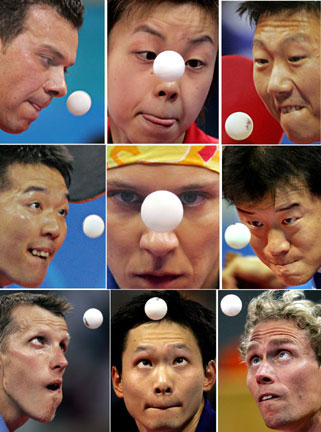
22. Ping Pong

The Idea: Yesterday's post described how the process of play can stimulate the eye-brain inter-sensory connection. Here are some more eye exercises in the form of games that kids and adults play all over the word.

Set Up: You'll need a smooth wall, a ping pong paddle and ball. If you're doing this with a friend, you might as well play a proper game of ping pong on a table. If your vision prevents you from playing ping pong, try something with a bigger racquet and ball—tennis, squash, badminton, etc. If this is still too challenging, use a soccer ball and a wall outdoors.

How To: This exercise has several variation based on the above options. All work best as vision exercises if they're done regularly—more than once a week:
• Ping Pong (or Tennis/Squash/Racquetball) for One: Practice hitting the ball with the paddle or racquet so that it bounces off the wall, intercepting it as it comes back, keeping score by seeing how many consecutive hits you can make.
• Ping Pong (or Tennis/Squash/Racquetball) for Two: Simply play ping pong on a ping pong table or any of the other sports on their usual courts.
• Soccer for One: Stand about 3 meters (10 feet) from a wall and kick the ball so that it bounces off the wall, intercepting it as it bounces back. Gradually work you way down to balls of smaller sizes, kicking, throwing, or paddling the, back and forth.

What's Going On: The movement of the ball traveling quickly toward and away from the eyes exercises focal abilities and depth perception, as well as stereoscopic vision.

Testimonial: One of high school teachers had become more myopic from all the reading she had to do in college. She knew this because as the semester dragged on, she had to sit closer and closer to the front of the room during lectures. She took up playing ping pong and tennis every day and soon regained her distance vision. Likewise, when I was a kid struggling with an eye disease that I did not yet understand, I played the soccer-ball-against-the-wall game outside and also practiced throwing and hitting a tennis ball against the walls in the hallway of my mom's apartment. I did these things intuitively, some piece of me knowing that that this was what I needed to do to preserve my vision. It worked, to some extent.

Tuesday, January 12, 2010

12. The Phantom Finger

The Idea: Our eyes are taking in every image in front of them—only the brain is selective about what it sees. Part of the work of natural vison therapy is training the brain what to see (eyes + brain = vision). We can also train our brains to see things that aren't actually there, therefore expanding the brain's ability to see what is actually there. And there's nothing like a common party trick to get the job done.

How To:
Step 1: Bring your index fingers to eye level, about 20 cm in front of the face with tips pointed at each other, about 1 cm apart.
Step 2: Look at the space between your fingers. Do you see a third, double-ended finger floating between them? Look for it.
Step 3: Once you've got your Phantom Finger established, move it around—bring the fingers slowly up and down to the edges of your visual field, move them closer and further away, close the eyes and then open them—always maintaining the visual belief that the Phantom Finger is still there.

What's Going On:
The eyes see two fingers, but the brain puts their back ends together to make a third, sausage-shaped finger in the middle. This works the eye/brain connection of stereoscopic vision and is a useful exercise for anyone who has a "lazy" eye or sees things more clearly in one eye than in the other. Step 3 of the exercise—using movement and closing the eyes—helps strengthen both the breadth of the visual field as well as ability to focus at different near distances, while training the brain to see what we want it to see.

More info:
• Dr. Marc Grossman loves using these kinds of eye-brain tricks to help people see. He's collaborated with artists on some "Magic Eye" books, saying that they're good for the vision—the eyes and he brain working together.

Wednesday, January 6, 2010

6. The 3-Finger Game

The Idea: Stereoscopic vision is the brain's ability to coordinate the separate images taken in by each eye and combine them into one image/idea. When the eyes focus on an object in a relaxed manner, the mind is focused and relaxed as well. The converse is true: when the eyes are straining to focus, the mind is strained and unfocused, which leads to more strain on the eyes. By getting the eyes to focus with relaxation, we relax the mind, paving the way for better vision.

How To:
Step 1: Sit or stand in front of a wall without any visual distractions on it. Hold one hand 15–20cm in front of your nose, the other twice that far, index fingers pointed up, other fingers curled down.
Step 2: How many index fingers do you see? Really there are only 2 fingers, but how many do you see?
Step 3: If you see 3 fingers, are the 2 that are side-by-side on the hand closer to your nose or further from your nose? Whatever the case, switch so that the double-finger is on the other hand.
Step 4: Keep switching, so that you see 2 index fingers on the hand closer your nose, then further, then closer, and so on.
Step 5: Should you drift into seeing any other
number of index fingers, relax into seeing 3.
Step 6: Remember to breathe, relaxing to switch rather than straining.

Variation—The 4-Finger Game: The 3-Finger Game can also be done with an additional point in the distance—a pine tree, telephone pole, church steeple, etc.—switching focus from the near finger to the further finger and then the far-off object. In focusing on this far-off object, how many index fingers do you see?

What's Going On:
• Each of our eyes sees its own version of reality from its own angle. When we focus on an object at a certain distance, the brain takes each eye's perspective and combines them into a single "3-D" image. Meanwhile images at other focal distances become distorted and part of the brain's job is to filter out this information. Our mental focus is in line with our visual focus.
• The 3-Finger Game works the eye/brain connection in being able to focus on things at different distances. In seeing one close finger and two further away fingers, we're exercising our ability to focus on close objects. Switching to seeing two close fingers and one further away finger, we're exercising our ability to focus on objects at a medium distance. In the variation where we look at a third object a bit further off (and presumably seeing 4 index fingers), we're exercising our distance vision.
• The key to the 3-Finger Game is being able to switch quickly between focusing on objects at different distances, seeing one of something and two of another with complete control. After practice, this ability to consciously master one's focal abilities will move from being an eye exercise and evolve into a vision habit, improving the everyday ability to focus—visually, as well as mentally.

Note: These drawings are exaggerated for illustrative purposes—the doubled fingers won't likely appear to be this far apart.

More info:
• Dr. Marc Grossman loves using these kinds of eye-brain tricks to help people see. He's collaborated with artists on some "Magic Eye" books, saying that they're good for the vision—the eyes and he brain working together.

Visitors:

º^º