Showing posts with label movement. Show all posts

Friday, January 22, 2010

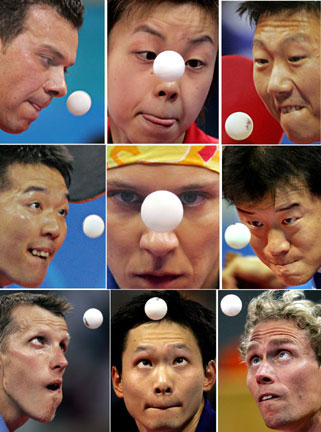
22. Ping Pong

The Idea: Yesterday's post described how the process of play can stimulate the eye-brain inter-sensory connection. Here are some more eye exercises in the form of games that kids and adults play all over the word.

Set Up: You'll need a smooth wall, a ping pong paddle and ball. If you're doing this with a friend, you might as well play a proper game of ping pong on a table. If your vision prevents you from playing ping pong, try something with a bigger racquet and ball—tennis, squash, badminton, etc. If this is still too challenging, use a soccer ball and a wall outdoors.

How To: This exercise has several variation based on the above options. All work best as vision exercises if they're done regularly—more than once a week:
• Ping Pong (or Tennis/Squash/Racquetball) for One: Practice hitting the ball with the paddle or racquet so that it bounces off the wall, intercepting it as it comes back, keeping score by seeing how many consecutive hits you can make.
• Ping Pong (or Tennis/Squash/Racquetball) for Two: Simply play ping pong on a ping pong table or any of the other sports on their usual courts.
• Soccer for One: Stand about 3 meters (10 feet) from a wall and kick the ball so that it bounces off the wall, intercepting it as it bounces back. Gradually work you way down to balls of smaller sizes, kicking, throwing, or paddling the, back and forth.

What's Going On: The movement of the ball traveling quickly toward and away from the eyes exercises focal abilities and depth perception, as well as stereoscopic vision.

Testimonial: One of high school teachers had become more myopic from all the reading she had to do in college. She knew this because as the semester dragged on, she had to sit closer and closer to the front of the room during lectures. She took up playing ping pong and tennis every day and soon regained her distance vision. Likewise, when I was a kid struggling with an eye disease that I did not yet understand, I played the soccer-ball-against-the-wall game outside and also practiced throwing and hitting a tennis ball against the walls in the hallway of my mom's apartment. I did these things intuitively, some piece of me knowing that that this was what I needed to do to preserve my vision. It worked, to some extent.

Thursday, January 21, 2010

21. Skipping Rope

The Idea: "Playing" is an exhibition of intelligence: the smarter an animal is, the more that animal plays. By playing, we test out ideas and learn from the results—both failures and gains. The challenges and rewards of playing is part of what keeps us motivated to play. All play stimulates the brain, and many everyday forms of playing work the eye-brain connection that we call vision. The next few episodes of 31 Eyes focus on common kids' activities that can help the vision.

Set Up For Skipping Rope:
All you need is an ordinary jump rope, or a length of cord a little longer than your arm span. Work outside with plenty of space for jumping and looking off into the distance.

How To: Twirl the rope from the back of your heels and over your head. Look straight ahead—don't look at your feet or at the rope. Practice skipping rope just by knowing where the rope is. From here you can "up-level" by:
• Alternating with foot you skip with
• Jumping with both feet simultaneously
• Speeding up the swing of the rope
• Changing the direction in which the rope travels
For this exercise, be sure to keep looking straight ahead, working to skip the rope without getting your feet caught before progressing on to another stage.

What's Going On: By looking straight ahead while skipping rope, peripheral vision is strengthened, as well as spatial and movement awareness. The sense of vision also works with the senses of hearing, touch, and kinesthetics, getting the brain to work with all the senses integrally.

More Info:
• Marc Grossman describes skipping rope as a vision exercise in his book Greater Vision.

Monday, January 18, 2010

18. Seeing The Invisible

The Idea: Things are easier to see when we know where they are. We can use senses other than vision to do this: we have two ears to be able to discern where in space a sound comes from, and our skin sends us messages about the location of different textures and temperatures. These other senses actually help us to see. Here are two exercises that help build on this ability:

How To:
Step 1: Sit or stand in a relaxed comfortable position. Raise one hand to eye level and rub the thumb and forefinger together.
Step 2: Keeping the eyes closed, look at your hand. Even though you can't actually see it, focus the eyes to where you know it to be.
Step 3: Keep rubbing your thumb and forefinger together as you move your hand around—down, up, right, left, nearer and further from the face. Follow your hand's movements with your closed eyes, switching hands if your arm gets tired.

Variation In Pairs:
The above exercise can be done with one person having eyes closed and another snapping fingers. The person with closed eys loks toward where the snapping sound is coming from.

What's Going On: When your eyes are closed, your brain has a general idea where in space your hand is. By rubbing your fingers together, your sense of touch feeds your brain more information about where your hand is. By keeping the eyes closed and directing them to your hand, your brain is sending your focus to a particular spot. This strengthens the ability to do this when the eyes are open. In the two-person variation, the same thing is happening via your sense of hearing instead of touch. Also the two-person variation is dealing with an unknown object—the other person's hand is not attached to you, so you cannot be certain where it is—whereas when you do this exercise with your own hand, the object is known. By doing both versions of this exercise, one can hone the coordination of the senses.

More Info:
• This exercise, and many others, can be found in Marc Grossman's book Greater Vision.

Friday, January 15, 2010

15. Sketching

The Idea: Part of seeing clearly is the ability to discern edges. When vision is blurred, one might not be able to tell the definite shape of something, or exactly where one object begins and another ends. By paying attention to edges, we can teach ourselves to better define what we see.

How To:
Step 1: Use the tip of your nose to trace the edges of things, (some people find it helpful to imagine that there is an incredibly long pencil extending from the tip of the nose).
Step 2: Move your head and eyes as you Sketch the edges of things near to you or far away, moving gracefully from object to object where their various edges intersect.
Step 3: As you practice this Sketching, notice the finer details of various objects—the leaves on a tree, the grain of a wooden floorboard, the inner and outer rims of a water glass, the eyelets and laces and stitching on a pair of shoes, etc. Sketch these objects' interior edges, as well as exterior.
Step 4: As with all exercises and vision habits, breathe deeply, relaxing the face, neck and shoulders.

What's Going On: By Sketching and noticing edges, the brain becomes interested in them and helps the eyes to sharpen the vision, thus reducing blur. Over time, you can Sketch objects with incredibly subtle movements of the head and eyes (as many people from non-western, less myopic cultures tend to do1). By Sketching regularly as an eye exercise, the eyes begin to do this naturally.

More Info:
• 1Thomas R. Quackenbush mentions the tendencies for most westerners to lock their necks whereas people in non-western countries tend to be more expressive in their head movements. See Quackenbus, Thomas R. Relearning to See. Berkeley: North Atlantic Books, 1997. This book also has a big section on Sketching.

The drawing above is by Philadelphia artist Jason Hsu and can be used as part of a Sketching exercise. I once saw Jason work on a single-line drawing—where he put his pen on a giant piece of paper and drew a picture without lifting the pen from the page—for 24 hours straight.

Thursday, January 14, 2010

14. Swaying & Swinging

The Idea: Everything around us is in motion. Walking down the street I see other people walking in various directions, bicycles and trolleys zooming up the avenue at different speeds, tree branches swaying in the wind, birds darting above against a backdrop of clouds floating leisurely across the sky. Even stationary objects appear to move when one is in motion. Riding the trolley past the park, the lampposts in the foreground appear to move by more quickly than the trees in the background, as dogs and squirrels and children run to and fro across the grass. All these things, moving in various ways, can be a soup of muddled vision for some. By accustoming the vision to motion, the eye-brain connection can learn to discern and differentiate the ingredients to that soup.

How To: Here are 2 versions of this exercise, each focusing on different depths of the visual field. Try doing them back-to-back, keeping the eyes and shoulders relaxed, breathing deeply:

Swaying:
Step 1: Hold one finger up about 30 cm in front of the nose.
Step 2. Keeping the finger where it is, shift your weight to your left foot and swing your head gently to the left so that the finger is visible only in the right eye. Next, shift your weight to your right foot, coming back though center, and then swinging your head gently to the right so that the finger is visible only in the left eye. Keep moving the head slowly from side to side with the weight of the body, looking straight ahead—not at the finger.
Step 3: Keep Swaying for 2-5 minutes, noticing the perceived movement of the finger. When you Sway to one side, which way does the finger appear to move in relation to the background?

Swinging:
Step 1: Hold one finger up about 30 cm in front of the nose.
Step 2. Keeping the finger in line with the nose, shift your weight to your left foot and swing your body in a 90º arc over to the left, moving the arm with the head. Next, shift your weight to your right foot, coming back though center, and then swinging over to the left. Keep moving from side to side with the weight of the body, looking straight ahead, finger still 30 cm in front of the face.
Step 3: Keep Swinging for 2-5 minutes, noticing the perceived movement of the background. When you Swing to one side, which way does the background appear to move in relation to the finger?

What's Going On: Swinging works with adjusting to background movements while keeping the eyes focused on something at a near distance. Swaying works with adjusting to closer movements while keeping the eyes focused on things at a medium or long distances. Both exercises together help the eyes stay focused without getting distracted, encouraging the brain to pick up this habit as well. Swinging and Swaying also help the body to loosen up, relaxing the muscles and helping to relax the eyes.

More Info:
• Swinging and Swaying are principle exercises in the Bates Method, developed by Dr. William H. Bate in the early 20th century, and espoused by many vision therapists today.
• Thomas R. Quackenbush’s paraphrasal of Bates is also a good one in his textbook Relearning to See (North Atlantic Books, 1997).
• This is a good exercise to pair up with the similar movements of Sunning.

Visitors:

º^º